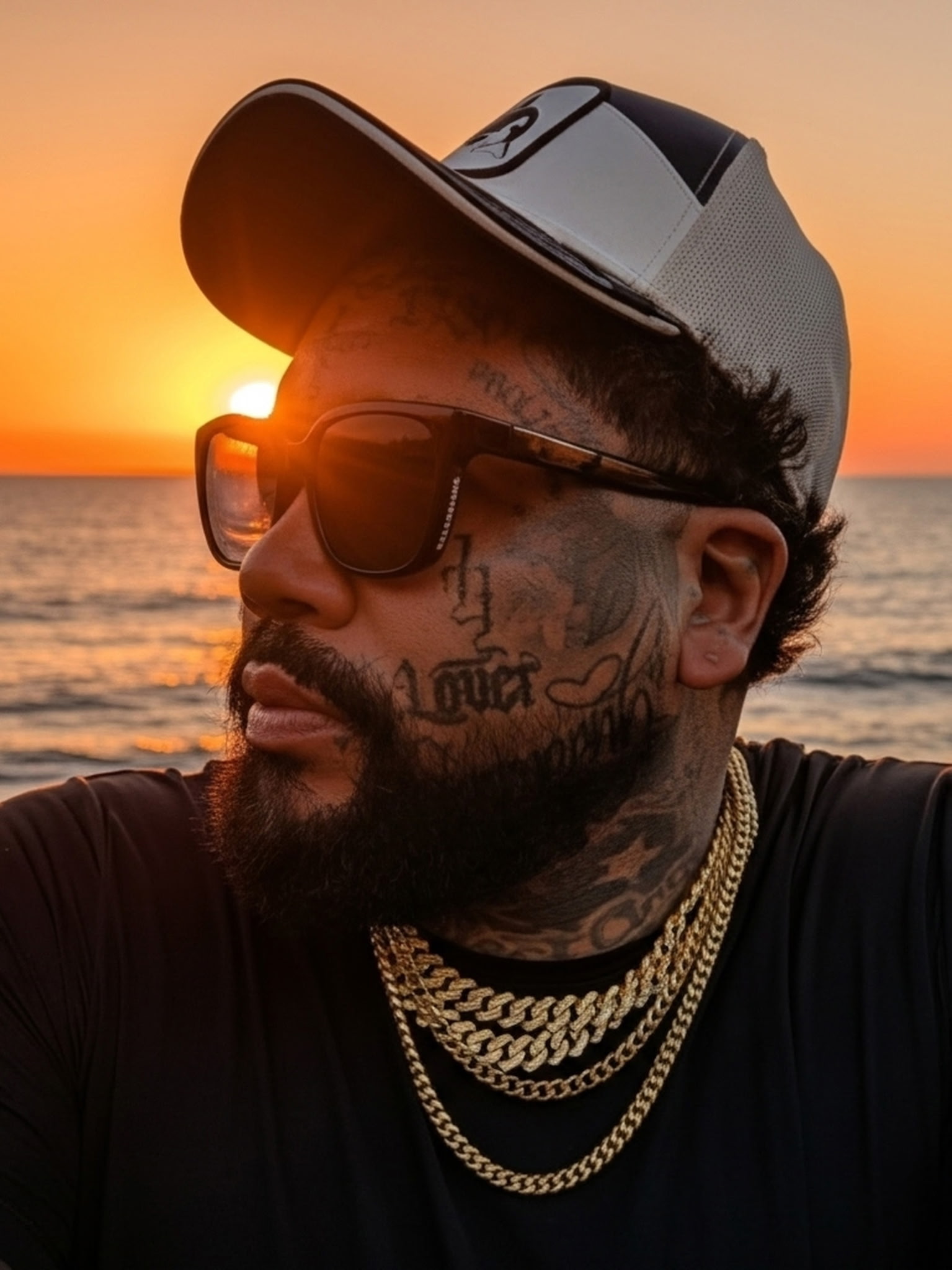
Joonah Stars doesn’t try to dress his story up. He tells it the way it is, and that’s exactly where his power comes from.
He was born in Hanford, California, and has spent the last decade living in Sacramento. That stretch of time didn’t unfold the way most people imagine when they think about building a life or chasing a dream. For Joonah, those ten years were spent inside the walls of a state prison. It’s a chapter that doesn’t just sit in the background of his music. It drives it.
When he talks about why people should listen to him, he doesn’t point to trends, influences, or industry comparisons. He puts it simply. He believes he’s speaking to something real. Pain, specifically. The kind people carry quietly. The kind that doesn’t always have a voice. His goal is to be that voice.
Growing up, Joonah was part of a big family. Three sisters, two brothers, both parents in the home. From the outside, it might sound like a full house with strong roots. But the reality was more complicated. The dynamics of his childhood and early adult life created distance that never fully closed. Today, he stays in touch with just one of his sisters. That separation, like everything else in his story, feeds into the emotional weight behind his music.
Interestingly, music wasn’t always the plan. Joonah didn’t grow up mapping out a career in the industry or studying artists to model himself after. There isn’t a specific influence he points to or tries to mirror. Instead, his entry into music came through someone close to him. A friend who was already making progress in the industry saw something in Joonah before he fully saw it himself. That push mattered. It was enough to get him to take the leap.
Even now, he doesn’t overanalyze what makes him stand out. In a world where artists are often expected to brand themselves down to the smallest detail, Joonah shrugs at the question. He hasn’t spent time trying to define a unique angle. He just tells his truth and lets the music speak for itself.
If there’s a moment he points to as a real turning point, it isn’t a release date or a performance. It’s getting off parole and probation. That kind of freedom hits different. It’s not just symbolic. It’s practical. It’s the ability to move, create, and build without limits hanging over your head. For Joonah, that’s been the real foundation for everything he’s trying to do now.
Still, the transition into music hasn’t been without its struggles. His biggest challenge isn’t a lack of ideas or ability. It’s overthinking. He admits he has a habit of holding onto songs instead of releasing them. Second-guessing, waiting for the right moment, or trying to perfect something that might already be ready. It’s a common trap, but one he’s actively trying to break out of.
Right now, his focus is clear. He wants his Spotify to take off. In his mind, the music is already there. The quality isn’t the question. The challenge is getting it heard. That’s where he’s putting his energy, figuring out how to push his sound beyond his immediate circle and into a wider audience.
He’s not rushing into a full album yet. Instead, he’s taking it one step at a time, releasing singles as they come, even if that process isn’t as consistent as he’d like. There’s also a major feature on the way with an artist named Exhstacy, something he hints at but doesn’t fully reveal just yet. It’s one of those “wait for it” moments that suggests there’s more in motion behind the scenes.
Ask him where he sees himself in five years, and he won’t give you a polished, strategic answer. There’s no detailed blueprint. Just a hope. Arenas. Bigger stages. Bigger reach. The kind of growth that turns personal stories into shared experiences with thousands of people at once.
At this stage, Joonah Stars isn’t trying to fit into the industry. He’s trying to find his lane in it. His story isn’t neat, and his approach isn’t overly calculated. But that’s part of what makes it feel real. He’s not presenting a finished product. He’s in the middle of becoming, figuring it out as he goes, and letting listeners hear that process in real time.
For people who connect with music that comes from lived experience rather than image, that might be exactly what they’ve been looking for.
More News, T-Pain Sues Akon’s Konvict Entertainment for $489K in Unpaid Royalties